Finger on the pulse

Curiosity, persistence and a keen sense of what’s feasible – this is Anik Thaler, whose start-up Fabas is developing plant-based foods that include local hummus and protein extracts made from fava beans.
For Thaler, plant proteins hold enormous potential – not just for the food industry, but for agriculture, too. “During my studies, I saw how much plant-based products were gaining traction. But I missed the connection to Swiss farming. I wanted to eat locally,” says the young entrepreneur, who studied agricultural sciences at ETH Zurich. What bothered her was the fact that many plant-based products relied on imported raw materials.
So she set out to change that. In 2021, together with a group of fellow students at ETH’s Student Project House, she developed a hummus made from Swiss chickpeas – and, at just 21, founded Fabas. Alongside this, she attended an evening entrepreneurship course at ETH. The product struck a chord, first appearing in organic shops, then on the shelves of a major Swiss retailer.
What began as a gap-year project soon became a full-time job. The team evolved as well. “At first, Fabas ran alongside my studies. But once I decided to fully commit to the company, the team underwent a reconfiguration too.” Today, Fabas consists of nine female employees – seven of them in food technology, many with ETH backgrounds.
“For plant proteins to reach the plate, we need a range of options that deliver on quality and taste.”
New direction for greater impact
Hummus was followed by falafel and a burger. But in 2025, the founders made a strategic shift. “Around 60 per cent of people in Switzerland identify as flexitarians and want to eat more plant-based foods. For that to happen, we need a range of products that convincingly meet people’s everyday needs and deliver in quality and taste,” Thaler says. While intensive research has been conducted on dairy processing for decades, plant-based production often suffers from a lack of technological expertise. That’s where Fabas comes in. Instead of developing its own end products, the company has now turned its attention to the value chain.
Working with the University of Applied Sciences in Sion, the team developed a gentle method for extracting protein from pulses. The resulting neutral-tasting protein extracts and pre-mixes from fava beans can be processed much like cow’s milk – into yoghurt, ice cream, cream cheese or cream. “A glance at supermarket chillers shows how saturated the dairy market is,” Thaler notes. “Plant-based alternatives, by contrast, still offer huge scope for innovation.” Fabas’ semi-finished products are therefore now targeted at dairies, enabling producers to develop new plant-based lines using existing infrastructure. The first products using Fabas extracts are already on the market. Meanwhile, the company is expanding production capacity in Germany, with the longterm aim of becoming one of Europe’s leading suppliers in this space.
© fabas
A raw material with potential
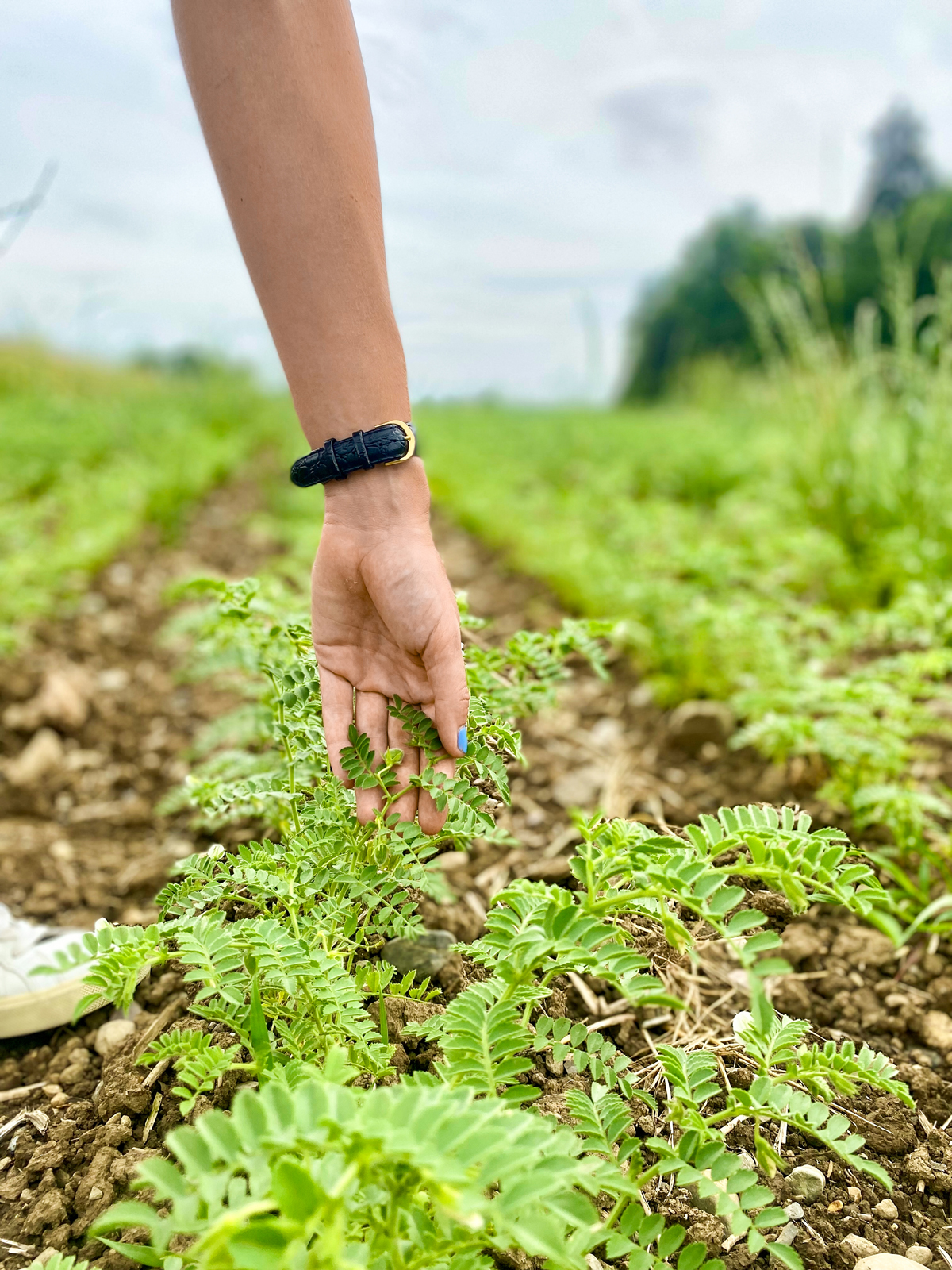
“Harvesting the power of pulses” – for Thaler, the company’s slogan is more than just a marketing tool. “Peas, beans and lentils fix nitrogen in the soil through their roots, so they can be grown without fertilisers. And pulses provide not just protein, but fibre too, which is essential for a healthy diet,” explains the entrepreneur, whose hobbies include ultracycling and triathlon. Nevertheless, consumption in Switzerland remains at around two kilograms per person per year, which is well below recommended levels. Thaler is determined to change that. As co-founder and board member of the Swiss Pulse Association, she’s pushing for more pulses on Swiss fields and plates.
She’s also true to her values in her private life. Together with her partner, she recently took over a farm in eastern Switzerland through the digital platform “Hofübergabe”. The organic farm Alterswil has extensive grassland, 200 standard fruit trees and 33 dairy cows – and soon, their own fava beans. For its products, however, Fabas sources raw materials through IP-Suisse, an organisation of around 18,000 farmers that coordinates the cultivation and marketing of agricultural produce. This allows the start-up to strengthen its ties to Swiss agriculture while ensuring stable supply chains for the quantities it requires.
Close ties with ETH
Thaler remains closely connected to ETH to this day, both in her exchanges with researchers working on projects in crop research and as a mentor for food start-ups at the Student Project House. “What’s great about start-ups in the food sector is how quickly you can test the foods – unlike with an app or even a medicine,” she says.
She’s therefore strongly in favour of expanding the Student Project House to include a Food Lab. “Easy access to a foodsafe environment and the right infrastructure can make all the difference for students with exciting ideas.”