Why are technological solutions alone not enough?
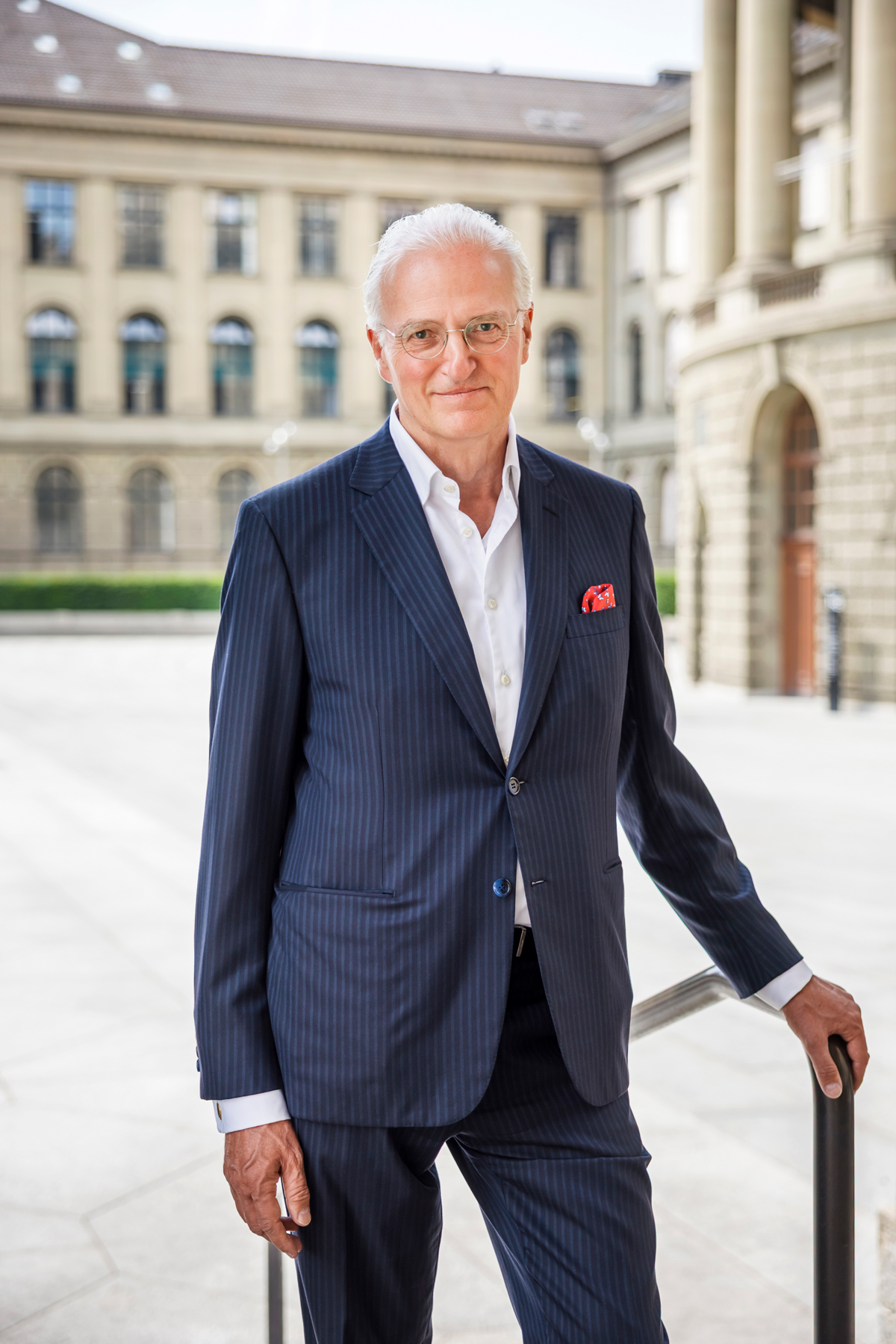
Technology is transforming markets, politics and society – often faster than we can understand its consequences. Gerhard E. Schmid, investor, philanthropist and former Schindler executive, supports the Albert Einstein School of Public Policy at ETH Zurich because he is convinced that the defining questions of our time require people who can combine scientific thinking and social responsibility.
You studied electrical engineering at ETH Zurich. In lectures, were you more likely to sit in the front row or strategically towards the back?
GERHARD E. SCHMID – More towards the back, I would say. Even as a young boy, I wanted to understand how things worked. I was often more interested in the bigger picture than in the details. And, to be perfectly honest, sport and singing in a fraternity were important to me as well.
What was the most valuable thing you learnt at ETH – and what did you feel was missing?
The most valuable thing was learning how to structure complex problems analytically. ETH instils tremendous intellectual discipline: thinking precisely, taking mistakes seriously and working step by step towards sound solutions. What I felt was somewhat lacking at the time was a stronger connection between technology and society. ETH in the 1980s was highly specialised and, in some respects, rather sterile. I am delighted to see that students at ETH today have far more opportunities to engage across disciplines, pursue entrepreneurial ideas and contribute to society.
You spent many years in business. How did that change your perspective on technology?
As a newly qualified ETH engineer, the first question you ask is: What is technically possible? In a company, the focus shifts: What problem are we solving, and for whom? Companies create enormous value in this way, but they do not automatically place the societal consequences of technology at the centre of their thinking. That is precisely why institutions such as ETH Zurich are so important: they can situate technological innovation within a broader societal context.

© ETH Foundation / Alessandro Della Bella
“The Einstein School is like a lighthouse: it does not simply provide ready-made answers, but sheds light on new horizons and points toward promising paths forward.”
Is that why you support the newly established Einstein School at ETH Zurich?
Exactly. I am convinced by its holistic, interdisciplinary approach. The major challenges of our time – from artificial intelligence, energy and health to demographic change – cannot be solved through technology or politics alone. This is precisely where the Einstein School comes in. It builds a bridge between clear-headed scientific logic and political feasibility, and between analytical depth and social responsibility. For ETH, this represents a powerful opportunity. It educates people who will later found companies, assume responsibility in public administration, organisations and research, and in doing so shape a city, a country and ultimately society as a whole. For me, the Einstein School is therefore like a lighthouse: it does not simply provide ready-made answers, but sheds light on new horizons and points toward promising paths forward.
The Einstein School places particular emphasis on transdisciplinary dialogue. Why is this important?
Because science, politics, business and society often speak different languages. Engineers seek to establish a clear overview of the facts and then identify the best solution. In politics, however, majorities, accessibility, acceptance and timing also matter. And in society, trust is essential. We therefore need places that can translate between these worlds; places where technical expertise meets political reality. Ultimately, decisions must be based on evidence, but they must also be understood and supported.
You are also committed to supporting young entrepreneurs, both at ETH and in emerging economies. What makes a start-up socially relevant?
A good start-up solves a real problem. It becomes socially relevant when it improves people’s lives over the long term or strengthens the functioning of society. Through the BPN Foundation, we coach entrepreneurs in emerging economies. The aim is to create jobs in the formal economy. In the long term, the companies that succeed will be those that combine commercial success with social responsibility. My younger daughter is currently also pursuing an entrepreneurial venture. With ODYS, she is developing a Web3-based application for the music sector. What fascinates me is how much she is learning in the process: about technology, law, business models and user needs. It is truly impressive, and, as a father, naturally wonderful to see.
What makes ETH a meaningful place for your philanthropic engagement?
I have been fortunate to receive opportunities in life, one of them being my education at ETH. I am grateful for what I was given and would like to help ensure that others are offered similar chances. There are many different ways to spend one’s money; I find it rewarding to invest in people, education and the future of our society. The Einstein School demonstrates the impact that this kind of support can have: not in the short term and not through grand gestures, but by empowering people to assess technological developments more effectively and make more responsible decisions for our society.

“Knowledge transfer is not a one-way process. Researchers need to understand the questions that concern policymakers and society. Decision-makers, in turn, need access to independent, scientifically grounded expertise. The Einstein School is specifically designed to advance this exchange.”
Professor Effy Vayena
Vice President for Knowledge Transfer and Corporate Relations, ETH Zurich
About
Gerhard E. Schmid is an investor, philanthropist and former member of Schindler’s global executive leadership. Following an international career in the lift and service industry, he now dedicates himself to education, entrepreneurship and social development. His focus is on promoting talent, innovation and responsible business practices. Through his involvement with the BPN Foundation, he also supports entrepreneurs in developing and emerging economies.